The feline skin and coat
 Your cat’s skin and coat make up a multi-functional super system. They are a barrier of protection, a convenient thermostat and water meter, as much as they are a barometer of your cat’s internal health. Your cat’s skin and coat also function as her largest sensory organ, as well as a very important communication tool.
In this article, we’ll explore the structure and function of the feline skin and coat. We’ll suggest ways to keep your cat’s skin and coat healthy, discuss the symptoms of an unhealthy skin and coat, issues that may arise and when to see the veterinarian as a result.
The structure of the skin and coat
When we refer to your cat’s skin, we’re talking about the entire organ that covers her body, making up around 20% (even up to 25%) of her body weight. Most areas of a cat’s skin are covered in fur, which can be thicker and longer in some areas and shorter and thinner in others – depending on the type of cat. Understanding the structure of the skin and coat will help owners to understand their function and make better decisions about their cats’ food, and skin and coat care.
Structure of your cat’s skin
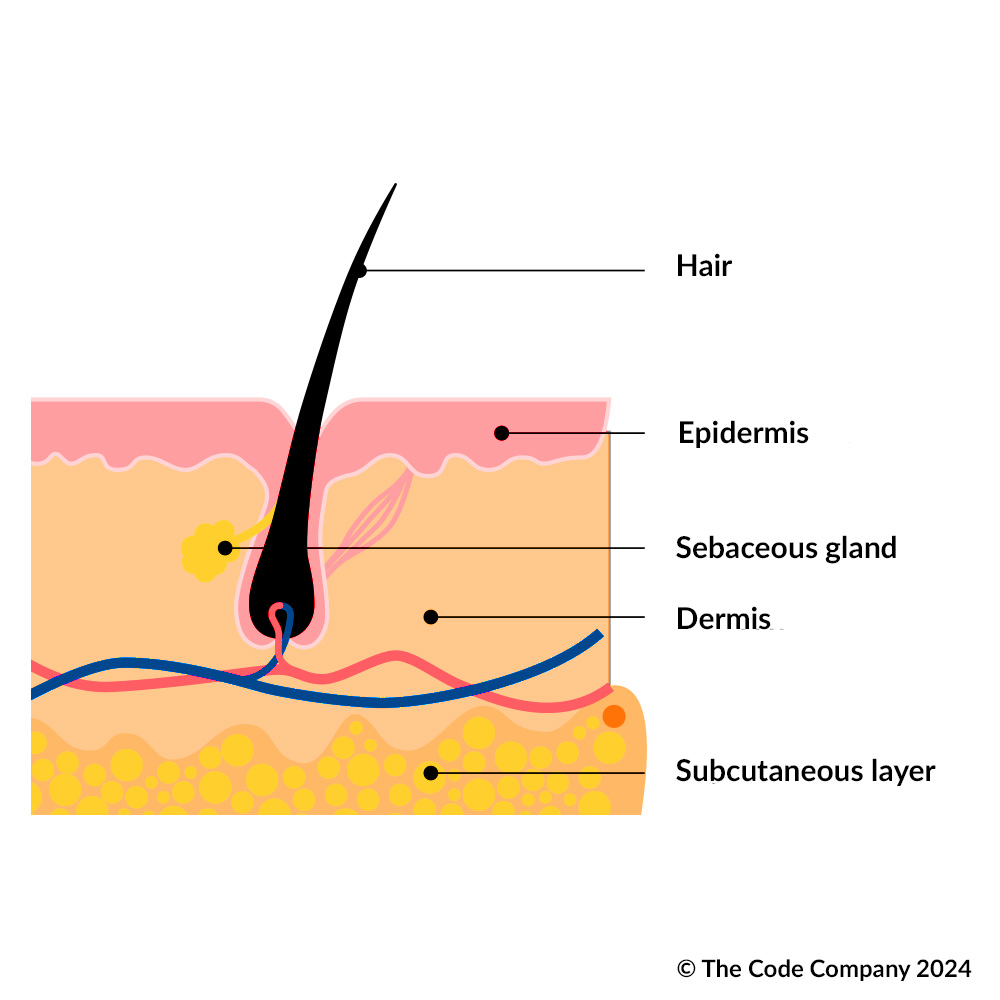 Your cat’s skin is made up of the epidermis (outer layer), dermis (middle layer), and subcutaneous layer or hypodermis.
- The epidermis helps to protect the sensitive dermis, and to stop the skin from drying out or your cat losing water via her skin. It produces keratin (from keratinocyte cells) and includes nails and fur.
- The dermis comprises your cat’s collagen layer and contains the hair follicles, skin oil (sebum), and sweat glands.
- The hypodermis or subcutis (literally ‘under skin’) or subcutaneous layer consists of blood vessels, nerves, and a layer of fat. The blood vessels feed the skin with nutrients and oxygen, while the layer of fat has an insulating effect. The hypodermis connects the skin to your cat’s muscles.
Structure of your cat’s coat
Your cat’s skin houses her fur coat, which is made up of tens of thousands of central and secondary hairs. Each compound follicle contains a central hair with a number of smaller, finer hairs growing from the same follicle. During shedding season, it’s usually the secondary hairs that are shed. As with dogs, the length and thickness of cat coats are determined by their DNA, and depend on their origins and breed.
Some cats have shorter, less dense coats – like the British shorthair cat, American and European shorthairs, the gorgeous Oriental shorthair and the velvety Burmese – while others have long, very thick coats; the Norwegian forest cat, Maine Coon and the Siberian cat all originated in icy cold environments, which account for their vast, protective coats. Some cats even have curly coats (Selkirk Rex, Cornish Rex, Devon Rex and LaPerm), while others have very little fur or no fur at all (think Sphynx cat, Donskoy, Peterbald or Elf cat). These hairless breeds are the result of a natural gene mutation, which was then isolated and selectively bred to produce this particular characteristic.
Cats have three types of fur that make up their coats:
- guard hair – this is the outermost coat that defines the cat’s colour, while also protecting her from moisture and injury
- awn hair – this is the ‘middle coat’ whose primary role is to insulate the cat from cold, heat and water, but it also lends some colour and texture to the cat’s outer coat
- down hair – also known as ‘vellus’, the down undercoat is super soft and is the cat’s ‘thermal underwear’ that offers temperature control in both cold and hot climates.
Bald and curly-coated cats’ characteristic coats are usually only made up of undercoat. Some hairless cats are born with a downy coat that becomes patchy or completely falls out at maturity. These cats need very careful and meticulous grooming to protect their skin and keep them healthy.
What is the purpose of a cat’s skin?
A cat’s skin has a range of functions:
- Protective barrier: Protection from the elements as well as from external injury.
- Immunity: Related to protection, the skin is the first barrier to infection and is part of the immune system that detects invasive pathogens.
- Water retention: Cats need to maintain their hydration levels. Aside from their drinking enough fresh water, the skin helps them to not suffer from water loss. Dry, flaky, unhealthy skin is prone to water loss, which can result in a range of other health problems.
- Excretion and marking: Cats excrete skin oils (sebum), sweat, as well as hormones. These excreted substances are then rubbed onto physical objects – trees, furniture, corners, and cat owners – as a way for cats to mark their territory.
- Internal communication: Highly sensitive nerves in the skin tell your cat whether she’s hot, cold, in contact with an object or experiencing pain. Her whiskers and certain hairs on her body are extra sensitive and send specialised sensory information to her brain.
- Source of nutrients: A cat’s skin serves as the temporary storage site of certain proteins, vitamins and minerals. When – for example – vitamin D precursors in the skin are exposed to sunlight, they convert to usable vitamin D in the body. Antioxidants like vitamins A and E are stored in the skin and used to maintain cells and protect the skin itself. Omegas-3 and 6 are also stored in the skin and work as anti-inflammatories when necessary for a cat’s wellbeing. When the cat secretes sebum from its oil glands, it helps to lubricate, feed and protect her coat.
What is the purpose of a cat’s coat?
- Protection: Whether long-haired with very thick guard and awn hairs, or curly-coated with only downy vellus, all cat fur offers some kind of protection from the external world. Hairless cats need a synthetic coat or ‘jumper’, especially in winter, and must be protected from exposure to UV rays to prevent sunburn and skin cancer.
- Thermoregulation: A cat’s coat has the special quality of helping to balance her body temperature. Whether insulation from the cold or protection against heat, thermoregulation is one very good reason to never shave a cat. If your long-haired cat has trouble keeping up with her self-grooming (especially in winter), you need to brush her daily to get rid of excess fur. Cats manage their body temperature in the summer and release body heat by grooming, licking their paws (through which they sweat), panting and resting in the shade or indoors during the heat of the day.
- External communication: Your cat’s coat can tell other animals to come closer or back off. When a cat is emotionally aroused (usually out of fear), she can raise her hackles (called piloerection) or stand her whole coat on end to make herself appear larger to scare off intruders. This sympathetic nervous response is caused when the hair follicles contract and the hair stands straight up.
- Aesthetic distinction: In the world of cat showing, cats’ coats are one of the standards upon which conformation is judged. While there is no biological reason for this purpose for a cat’s coat, it is one of the motivations for breeding cats and a determining factor in selective breeding development.
How to keep a cat’s skin and coat healthy
Now that we’ve covered the form and function of the feline skin and coat, it’s important to note that there are many things cat owners can do to keep our cats’ skin and fur healthy.
Keep your cat’s skin and coat healthy with good nutrition
What food is good for cats’ skin and coat? Since cats’ skin structure is mostly made up of proteins (collagen and keratin) and fatty acids, it’s crucial to feed your cat with a scientifically formulated cat food that contains high-quality proteins and the right balance of omega-3 and -6 fatty acids. A blend of high-quality ingredients – including a small amount carbohydrates and enough fibre – should help to keep your cat’s skin nourished, supple and able to function properly. Your cat’s nutrition should also contain the optimal blend of vitamins and minerals, which support skin and coat health as well as the health of all her other bodily systems. If her entire body is optimally fed, her skin and coat will be healthy too.
Support your cat’s skin and coat health with supplements
Some cats need additional skin-nourishing supplements, which contain a concentrated formula of EPA and DHA (omega-3s), zinc, linoleic acid (omega-6) and B vitamins. These all help to keep the skin moisturised and the coat looking shiny and healthy.
Support your cat’s grooming routine
Even though cats keep themselves meticulously clean (for the most part), it’s still important to keep an eye on your cat’s fur and do your part in grooming her to keep her skin and coat healthy. Her skin and coat will reveal a lot about her internal health: a dry, flaky, red skin and dull coat could be an indication that she’s not getting enough (high-quality) nutrients, has a digestive tract problem, or her kidneys and/or liver are having a hard time processing and eliminating nutritional waste products. Hormone issues like hypothyroidism, or stress, chronic illnesses like cancer, and internal and external parasites can disrupt your cat’s whole-body health, which then shows up as dry skin and dull fur.
Grooming herself is a physical task that requires flexibility and energy, so if your cat is overweight or has arthritis, she may not be as efficient with her grooming as she would like to be, and may end up with mats and tangles in her fur. Regular brushing and the occasional bath will help to keep your overweight or arthritic cat looking and feeling her best.
Also, during shedding season, especially long-haired cats may find it difficult to keep up with their grooming needs, and excessive grooming can lead to hairballs. Considering all of the above, it’s a good idea to groom your cat once or twice a week by brushing or combing her and getting rid of excess fur. Not only will this also help your cat to distribute skin oils through her fur, but a little bit of bonding goes a long way!
Keep your cat’s parasite control regimen up to date
Whether you give your cat a tablet for internal parasite control or whether you apply a spot-on treatment for ticks and fleas, make sure you apply the medication at the recommended intervals. External parasites can trigger allergies (like flea allergy dermatitis), pain and itching, which can set off a chain of scratching and infection. A healthy skin and coat are no place for pests!
If you’re concerned about your cat’s coat and skin, speak to the vet about a good skin and coat care regimen. If her skin is very oily or very dry, the treatment will vary, so only the veterinarian can advise you correctly on the ideal healthy skin solution for your cat.
Symptoms of illness in your cat’s skin and coat
Since your cat’s skin and coat are so closely connected to other organs and systems in the body, this is one of the first places where symptoms of imbalance will show up. Some of the skin and coat symptoms you might observe with an unhealthy cat include:
- dandruff, flaky skin (associated with hormone imbalance or digestive upset)
- extremely dry skin (associated with kidney disease)
- itchiness and inflammation (associated with ticks and fleas, or food allergies)
- hotspots (associated with anxiety or pain-relief behaviour)
- excessive shedding (associated with high stress or allergies)
- patchy fur (associated with mange, fungal infection, inflammation and chronic scratching)
- formation of hard, dry calluses – hyperkeratosis (associated with chronic liver disease, or ageing)
Sometimes cats simply have a genetic predisposition to dry, itchy skin and/or allergic reaction to food or environmental allergens. It’s important for your cat’s wellbeing that these symptoms be managed with diet, medicated shampoo, and/or removing her from allergy-triggering environments; even if it’s for the rest of her life.
When should you see a vet about your cat’s skin and coat?
Any skin and coat symptoms that appear on your cat should immediately be checked out by the veterinarian. Because the skin and coat are affected by so many of your cat’s organs and body systems, it can be difficult and time-consuming to diagnose the underlying cause of the symptoms.
Keep a record of when the symptoms started. Do they flare up during a particular season? (Could be due to environmental allergies.) Do they flare up after your cat eats? (Could be due to food allergies.) Have the symptoms been getting progressively worse? (Could be due to a chronic illness.) Maybe there’s a genetic component to a worsening skin condition. The vet can perform blood tests, intradermal testing or a skin-scrape to find the culprit in your cat’s skin and coat symptoms.
It's impossible for the vet to try to determine the cause of poor skin and coat condition without performing a physical examination and receiving information about her diet, lifestyle and behaviour, so make an appointment if you have any concerns about your cat’s health.
How can I improve my cat’s coat and skin? Once you’ve received a diagnosis and/or a recommendation, follow the vet’s advice to the letter. At-home compliance with veterinary advice is critical in ensuring your cat’s condition improves and her wellbeing is restored.
Conclusion
One of the first indicators of a healthy cat can be found in her smooth, hydrated skin and shiny coat. She just looks full of vitality and health. Keep her well-fed and regularly groomed, and if you notice any symptoms of dry, flaky, itchy skin, take your cat to the vet for a check-up, advice and treatment, where necessary.
© 2024 Vetwebsites – The Code Company Trading (Pty.) Ltd.